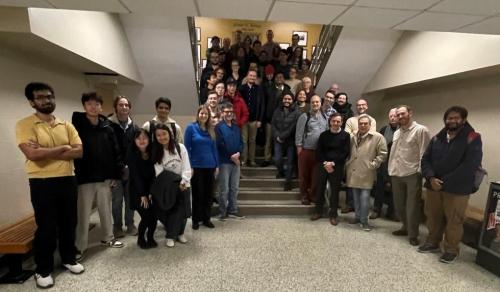
At the end of this semester, Professor Allan Drazen will retire. Professor Drazen came to the University of Maryland Department of Economics in 1990 as a tenured professor. He has published 71 articles, 14 in the coveted top five journals in economics. He has also served as an editor for six journals, including the top journal of the American Economic Association, the American Economic Review, as well as the top journal for the European Economic Association, the Journal of the European Economic Association. Professor Drazen is primarily an applied economic theorist. His body of research spans many areas of economics, including macroeconomics, international economics, and political economy. He is probably best known for his work in political economy.
His most cited paper, with over 3800 cites on Google Scholar, is “Why Are Stabilizations Delayed?” with Alberto Alesina, published in the American Economic Review. In the paper, Professors Alesina and Drazen provide a new explanation for delay in agreeing to adopt socially beneficial policies where the costs of the policy will be borne unequally by different groups. Each group, uncertain about who will concede first, waits to agree to policy adoption hoping to force an agreement where costs are born disproportionately by the other party. The delay comes at the expense of the public in a “game of chicken”. This important observation has obvious relevance to contemporaneous cross-party legislative bargaining.
Another major contribution is to the understanding of the political budget cycle. Professor Drazen showed that whereas politicians in established democracies in general do not increase fiscal expenditures near election time to achieve a short-term boost in economic activity and influence elections, politicians do manipulate budget cycles with greater frequency in new democracies, up to the first four elections after the transition to democracy. The political budget cycle in new democracies accounts for the finding of a budget cycle in larger samples that include these countries and disappears when they are removed from the larger sample.
Another well-known paper, “Threshold Externalities in Economic Development,” by Allan Drazen and Costas Azariadis, published in the Quarterly Journal of Economics, explores why some countries grow rapidly while others remain stuck in poverty. The authors explain that countries can fall into what’s called a “poverty trap.” The basic idea is this: when people invest in education, they don’t just improve their own skills. They also contribute to the overall level of knowledge in society. As more people become educated, it becomes more rewarding for others to get educated too—because there are more ideas, better jobs, and stronger institutions that make education pay off. This can create a “virtuous cycle.” More education leads to more knowledge, which makes education even more valuable, which encourages even more education. Over time, this process can help a country “take off” and experience sustained economic growth. But the reverse can also happen. If few people invest in education, the overall level of knowledge remains low. In that case, education may not seem very rewarding, so people have little incentive to pursue it. This creates a negative cycle where low education leads to low growth, and low growth discourages further investment in education (“human capital”). As a result, small differences in education levels at the beginning can grow larger over time. Two countries that start out s similar may end up on very different paths—one growing steadily, the other stagnating. The authors suggest there may be a threshold level of education: countries above it tend to keep growing, while those below it struggle to make progress.
In addition to his prominence as a researcher, Professor Drazen has had additional impact on the discipline of economics from training graduate students. He has mentored 43 Ph.D. students in his time at the University of Maryland. His former students have taken positions at universities around the globe, including institutions such as the London School of Economics and Stanford University. The department will miss Professor Drazen and wishes him the best in his retirement. We hope to retain him as a Professor Emeritus and to continue to see him around the department.